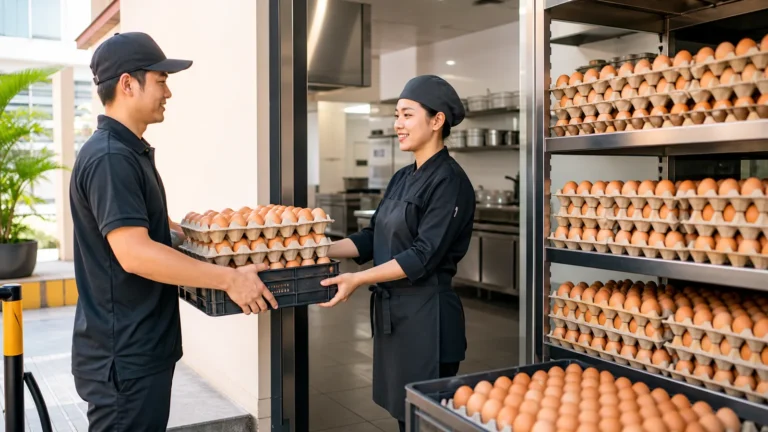
Choosing an egg supplier in Singapore is easier when the kitchen uses a written evaluation instead of impressions formed during a busy shift. A suitable supplier should fit the way your kitchen orders, receives, stores and communicates. A clear evaluation also protects staff time: fewer surprises at receiving means fewer calls, recounts and last-minute substitutions during service. The best decision is based on operational fit, not price alone. Document the answers so managers can compare options consistently and review the arrangement after the first few deliveries.
This guide is designed for Singapore restaurants, cafés, bakeries, caterers and hawker operators. Adapt it to your menu, premises and food-safety plan, and follow supplier directions and Singapore Food Agency guidance.

Quick checklist
- What businesses do you serve
- Which egg formats are available
- What delivery areas are covered
- Which schedules can be supported
- How are changes communicated
- What happens when demand increases
- How are discrepancies handled
- What information appears on delivery
- Can the arrangement scale
- Is the service dependable in practice
1. What businesses do you serve
Ask whether the supplier regularly supports restaurants, bakeries, caterers, cafés or hawker operators with recurring needs. A supplier used to trade customers will already understand order cut-offs, invoicing and delivery windows that household-focused sellers rarely handle.
Ask what order size is typical for them, so you know whether your volume is routine business or an edge case for their operation.
2. Which egg formats are available
Confirm sizes, tray formats and pack quantities before calculating portions, storage and recipe costs. Egg size affects baking consistency as much as it affects cost.
Check that the format you trial is the format you will actually receive each week, so early tests reflect the ongoing arrangement.
3. What delivery areas are covered
Check your exact Singapore address and any access restrictions rather than assuming islandwide service. Loading bays, lift access and hawker-centre unloading rules can all affect whether a scheduled window is realistic.
Describe the receiving point honestly during the first conversation; it is better to surface an access problem before the first delivery than during it.
4. Which schedules can be supported
Discuss daily, weekly or monthly requirements and how recurring orders are confirmed. Ask what the cut-off time is for changes and how standing orders behave across public holidays.
A schedule that works on paper only works in practice if both sides know exactly when an order becomes final.
5. How are changes communicated
A clear contact method matters when volume, delivery timing or location instructions change. Confirm who answers messages, on which channel and during which hours.
Urgent changes should not depend on one person’s mobile number being reachable; ask what the backup path is.
6. What happens when demand increases
Ask how early the supplier needs notice for festive periods, promotions, catering jobs or new outlets. Peak seasons stretch every supplier, so the useful answer is a specific lead time rather than a general reassurance.
A supplier who explains their capacity honestly is more dependable than one who promises everything without qualification.
7. How are discrepancies handled
Agree on the process for reporting incorrect quantities, visibly damaged trays or other receiving issues. Clarify what evidence is expected, such as photographs, counts and timing, and how quickly credits or replacements are confirmed.
A defined process protects both sides and keeps individual deliveries from turning into negotiations.
8. What information appears on delivery
Useful delivery documentation helps staff match the drop with the order and record stock accurately. Check that quantities, formats and order references appear clearly enough for a new employee to verify the delivery without help.
If documentation is thin, agree what the delivery message or note will contain before the first order rather than after the first dispute.
9. Can the arrangement scale
Discuss whether the ordering routine can grow with new menu lines, longer opening hours or additional locations. Changing supplier in the middle of a growth period is disruptive, so it is worth knowing the ceiling of the arrangement early.
Ask how orders for a second outlet would be handled; the answer reveals how much flexibility the supplier really has.
10. Is the service dependable in practice
Evaluate responsiveness, clarity and consistency during the initial ordering period before making a long-term decision. Treat the first month as a working trial and keep notes beside the receiving records.
Patterns in small problems predict how bigger ones will be handled later.



Compare suppliers with a consistent scorecard
Create a short scorecard before requesting quotations. Include product and pack suitability, delivery coverage, order cut-off, communication, discrepancy handling and the ability to support demand changes. Weight the factors according to operational importance rather than giving every answer equal value. A bakery may prioritise consistent pack formats and production planning, while a breakfast operator may place more weight on delivery timing and rapid communication.
Use the first several deliveries as a controlled evaluation period. Record whether quantities match, packaging arrives in good condition, delivery information is clear and questions receive timely answers. Ask the receiving team for feedback because they experience the service directly. One isolated issue may be correctable, but repeated uncertainty around timing, quantities or escalation is a sign that the arrangement needs review.
Price should be compared on a like-for-like basis, including pack quantity, delivery frequency, ordering effort and the operational cost of shortages or repeated discrepancies. The lowest unit price is not automatically the best overall value. When you choose an egg supplier in Singapore, document why the selected arrangement fits the kitchen and set a review date after the initial period.
Before signing off, confirm the exact ordering channel, the information required in each message and the person authorised to make changes. Store these details where both purchasing and kitchen managers can access them. Clear handover instructions prevent missed orders when the usual contact is on leave and make the supplier relationship easier to manage as the business grows.
Frequently asked questions
How often should the supplier arrangement be reviewed?
Review it monthly and whenever sales patterns, menu items, storage space, supplier arrangements or staffing change. Use actual kitchen records rather than memory.
Who should own the supplier relationship?
Choose a role that sees both ordering and receiving information, then train a backup so the routine continues during leave or shift changes.
Put the checklist into practice
A structured supplier evaluation turns day-to-day observations into better purchasing decisions. Start with the questions above, keep the records simple and improve the arrangement using real usage and receiving data. For recurring egg supply, contact Hup Seng Fresh Eggs Supplier, learn about our local service on the About page, and consult the Singapore Food Agency’s food-safety guidance.