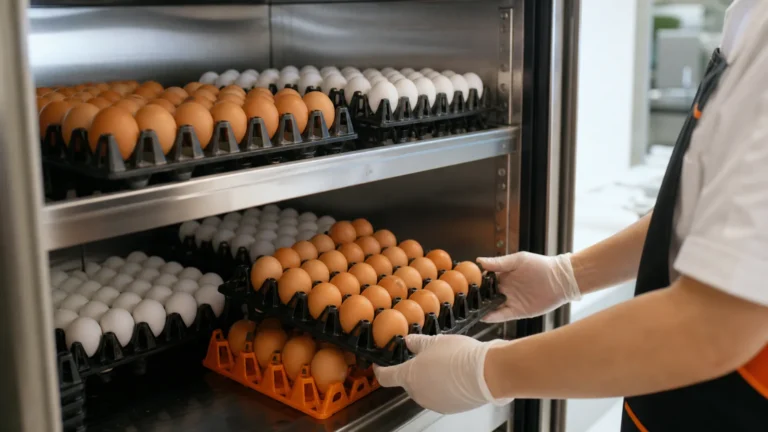
A commercial egg delivery checklist turns receiving into a quick, repeatable routine instead of a judgement call made during a busy shift. A short receiving routine helps kitchens find discrepancies before stock enters storage, while they are still easy to resolve with the supplier. Consistent receiving also improves ordering accuracy and communication between service, kitchen and purchasing teams.
This guide is designed for Singapore restaurants, cafés, bakeries, caterers and hawker operators. Adapt it to your menu, premises and food-safety plan, and follow supplier directions and Singapore Food Agency guidance.

Quick checklist
- Prepare before the vehicle arrives
- Confirm supplier and order details
- Count trays and cartons
- Inspect outer packaging
- Check visible shell condition
- Record discrepancies immediately
- Confirm corrective action
- Move accepted stock to storage
- Label and rotate the delivery
1. Prepare before the vehicle arrives
Clear the receiving area, have the purchase order ready and assign a trained person to inspect the delivery. A prepared receiving point shortens the driver’s wait and prevents trays from being left in walkways while paperwork is found.
Keep the checklist and a pen or device at the receiving point itself, so the routine starts the moment the vehicle does.
2. Confirm supplier and order details
Match the delivery with the expected supplier, date, order reference and receiving location. Thirty seconds with the delivery note prevents the wrong drop from being unpacked into working stock.
If anything on the note does not match the order, pause the unpacking and check before the driver leaves.
3. Count trays and cartons
Verify the delivered quantity against the order before packaging is moved away from the receiving point. Counting at the door, in front of the driver where practical, makes any shortage undisputed and easy to document.
Count in the format you ordered, whether trays or cartons, and convert to eggs only afterwards to avoid arithmetic mistakes mid-delivery.
4. Inspect outer packaging
Look for crushed corners, moisture, stains, unstable stacks or evidence that trays shifted during transport. Outer damage is the earliest warning of hidden breakage.
Open and check any carton that looks compromised before signing, and note the condition on the delivery record while the evidence is in front of you.
5. Check visible shell condition
Sample accessible trays and separate eggs with cracks, leakage or unusual contamination according to kitchen procedure. A consistent sampling habit, checking the same number of trays at every delivery, makes quality trends visible across weeks.
Record what was sampled as well as what was found, so a clean delivery is documented evidence rather than an assumption.
6. Record discrepancies immediately
Photograph and note shortages, substitutions or damage while the delivery is still being checked. Records made at the door carry more weight with suppliers than reports assembled hours later from memory.
Use a fixed format for every report: what was ordered, what arrived, what was wrong and who observed it.
7. Confirm corrective action
Contact the supplier promptly and record whether the issue will be credited, replaced or otherwise resolved. Note the agreed outcome next to the original discrepancy so follow-up does not depend on whoever took the call.
Close the loop at the next delivery by checking that the credit or replacement actually appeared.
8. Move accepted stock to storage
Put eggs away promptly in the designated area and avoid leaving trays in loading or preparation zones. The receiving job is finished when stock is on its shelf, not when the vehicle leaves.
Move stock in stable loads rather than tall stacks; most receiving breakage happens in the last ten metres.
9. Label and rotate the delivery
Apply the kitchen’s date label and position accepted eggs behind older suitable stock so first in, first out happens by default. A delivery that is labelled and rotated immediately never needs to be re-sorted during service.
Make the label legible from the front of the shelf, because a date no one can see does not rotate anything.



Make receiving checks consistent
Train a backup receiver and keep the checklist beside the delivery records. Consistent checks make discrepancies easier to resolve and protect stock rotation across every shift.
Review the checklist after any delivery that produced a discrepancy, and adjust the step that let the issue through rather than adding new steps everywhere.
Frequently asked questions
How often should the receiving checklist be reviewed?
Review it monthly and whenever sales patterns, menu items, storage space, supplier arrangements or staffing change. Use actual kitchen records rather than memory.
Who should own receiving?
Choose a role that sees both ordering and receiving information, then train a backup so the routine continues during leave or shift changes.
Put the checklist into practice
A dependable receiving routine turns day-to-day observations into better purchasing decisions. Start with the checks above, keep the records simple and improve the routine using real usage and receiving data. For recurring egg supply, contact Hup Seng Fresh Eggs Supplier, learn about our local service on the About page, and consult the Singapore Food Agency’s food-safety guidance.